Freight damage is one of the most common and costly problems in industrial logistics. When goods arrive damaged, the impact goes far beyond replacing stock. It leads to delivery delays, insurance claims, operational disruption, frustrated customers, and in some cases lost contracts.
One of the most effective ways to reduce freight damage is also one of the most overlooked. It starts with pallet design. When pallets are engineered specifically for the load they carry, damage risk drops dramatically across handling, transport, and storage.
Why standard pallets increase freight damage risk
Standard pallets are built for average loads and generic dimensions. Industrial products are rarely average. Machinery, components, cartons, and export freight all place different stresses on a pallet during transport.
When a product does not properly fit the pallet, overhang becomes an issue. Overhang exposes edges to impact and compression damage during stacking and forklift handling. Incorrect deck spacing can cause point loading, leading to cracked cartons, bent components, or pallet failure.
Uneven weight distribution is another major risk. When the pallet is not designed to support the load’s centre of gravity, flexing occurs. That flexing is amplified by vibration during road, rail, or sea transport, increasing the chance of product movement and breakage.
Custom pallet design eliminates these risks by building the pallet around the product, rather than forcing the product to adapt to a generic pallet.
How custom pallet design protects freight
Custom pallets are engineered to suit the exact dimensions, weight, and handling requirements of the load. This approach controls movement, improves stability, and reduces damage at every stage of the supply chain.
Accurate pallet dimensions ensure the product sits fully within the pallet footprint. This removes overhang and reduces exposure to impact during handling and stacking.
Load bearing components are positioned to evenly distribute weight across the pallet structure. This prevents bending, sagging, and stress points that often cause product or pallet failure in transit.
Fork entry points are designed to suit how the pallet will be handled. Whether the load is moved by forklift, pallet jack, or crane, reinforced lift zones help maintain stability and reduce handling damage.
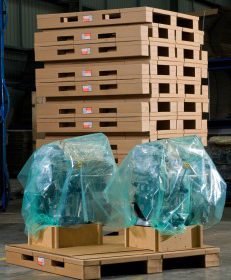
For high value or irregular loads, restraint features such as cleats, chocks, or integrated bracing can be built directly into the pallet. These features prevent shifting during braking, vibration, or container movement.
At CMTP, custom pallet design is supported by in-house engineering and 3D design tools. This allows customers to review pallet performance and load support before production begins.
Reducing freight damage across transport modes
Freight damage risk increases when goods move across multiple transport methods. Road, rail, and sea freight all introduce different forces that can destabilise poorly designed pallets.
For export freight, pallets must withstand long transit times, container movement, and exposure to moisture. Custom export pallets designed to ISPM 15 standards reduce both freight damage and quarantine risk. CMTP manufactures compliant export pallets nationally.
For domestic distribution, repetitive forklift handling is a leading cause of damage. Custom pallets designed for consistent fork spacing and balanced loads reduce impact damage and misalignment in busy warehouses and distribution centres.
For heavy machinery and oversized equipment, custom pallets and skids are designed to prevent twisting during lifting. This is critical when loads are crane lifted or transferred between transport methods.
The cost benefits of reducing freight damage
While custom pallets may have a higher upfront cost than standard options, they often deliver significant savings over time.
Fewer damaged goods mean fewer replacements, fewer insurance claims, and fewer delays. Stable pallets also reduce the need for corrective handling, which lowers labour costs and improves workplace safety.
In many cases, businesses that move to engineered pallet designs see a lower total cost per shipment, even with higher specification pallets.
Designed for compliance and consistency
In regulated industries such as food, pharmaceuticals, and export manufacturing, pallet design must meet strict compliance requirements. HACCP certified pallets reduce contamination risk, while export certified pallets prevent costly border delays.
CMTP designs pallets that meet these standards while maintaining a strong focus on freight protection. This combination of compliance and engineering expertise is critical for businesses shipping high value or sensitive products. More information on CMTP’s pallet manufacturing capabilities can be found at https://www.cmtp.com.au/products/pallets/.
When custom pallet design makes the most sense
Custom pallet design is especially valuable when products are high value, fragile, heavy, or irregularly shaped. It is also an effective solution when freight damage is recurring and needs to be addressed at the root cause.
If your business ships machinery, export goods, food products, or oversized loads, custom pallet design is often the simplest way to reduce freight damage without changing transport providers or routes.
For further guidance on how load stability affects transport safety, Safe Work Australia provides independent information.
FAQs about custom pallet design and freight damage
How does custom pallet design reduce freight damage
Custom pallet design matches the pallet to the product’s size, weight, and handling method. This reduces movement, overhang, and uneven loading that commonly cause freight damage.
Are custom pallets only needed for heavy or oversized loads
No. Custom pallets are equally effective for smaller or lighter products, particularly where stability, stacking, or compliance is critical.
Do custom pallets slow down warehouse handling
In most cases, they improve handling efficiency. Correct fork entry, balance, and stability make pallets easier and safer to move.
Are custom pallets more expensive than standard pallets
The initial cost may be higher, but reduced damage, fewer claims, and fewer delays often result in a lower overall logistics cost.
Can custom pallets be used for export freight
Yes. Custom export pallets can be designed to meet ISPM 15 requirements while protecting goods during long distance and sea transport.
How long does it take to design a custom pallet
With in house design and quoting systems, custom pallet designs can often be completed quickly, including visual approval before production.
Do custom pallets support HACCP and other compliance standards
Yes. Custom pallets can be manufactured to meet HACCP, ISO, and other industry requirements where needed.
Can custom pallets be supplied consistently across multiple locations
Yes. With national manufacturing capability, CMTP produces consistent pallet designs across multiple sites to support large scale operations.
Are custom pallets suitable for long term supply programs
Custom pallets are ideal for ongoing supply programs where consistency, efficiency, and damage reduction are priorities.
Talk to CMTP about reducing freight damage
If freight damage is impacting your operations, custom pallet design is one of the fastest ways to address the problem at the source. CMTP works with businesses across Australia to design pallets that protect products, meet compliance requirements, and reduce total logistics cost.
Speak with the CMTP team to review your current pallet setup or request a custom design.