Quick answer
The right export packaging for fragile equipment depends on the freight conditions, handling risks, moisture exposure, and the equipment itself, not just the crate dimensions. Good export packaging protects against movement, vibration, moisture, and compliance issues during transport, reducing the risk of freight damage, delays, and rejected deliveries.
Key takeaways
Export packaging should be built around the freight journey
Sea freight, forklifts, storage conditions, and multiple handling points all affect how equipment should be packaged.
Moisture is one of the biggest causes of freight damage
Condensation inside containers can damage electronics, corrode metal surfaces, and weaken packaging during long international shipments.
Standard pallets are not always suitable for fragile equipment
Heavy or sensitive machinery often needs custom pallets, restraint systems, and export crates designed around the load itself.
ISPM 15 compliance matters for international shipping
Non-compliant timber packaging can cause delays, shipment rejection, or destruction at the destination port.
Good packaging reduces operational risk, not just freight damage
The right export packaging helps prevent downtime, replacement costs, delayed installations, and customer issues.
Most export damage happens after the freight leaves your site
A CNC machine leaves Melbourne in perfect condition.
Six weeks later it arrives overseas with moisture damage inside the control cabinet, impact damage on the frame, and components shifted inside the crate.
The equipment itself was fine.
The export packaging wasn’t.
That’s the part many businesses underestimate. Machinery and fragile industrial equipment can survive years inside a manufacturing environment, then fail somewhere between a forklift, shipping container, and destination warehouse because the packaging wasn’t designed for the transport conditions.
Export packaging is there to protect the equipment from everything that happens after it leaves your site.
That includes:
- Forklift handling
- Container movement
- Vibration during transport
- Moisture exposure
- Port storage
- Crane lifting
- Multiple freight transfers
- Long shipping durations
The right packaging reduces risk before the freight moves, not after something goes wrong.
Why export packaging starts with freight conditions
One of the most common mistakes businesses make is focusing on crate dimensions before understanding the freight journey.
The freight conditions determine the packaging requirements.
A machine moving from Melbourne to Sydney experiences very different risks compared to equipment spending seven weeks inside a shipping container heading to Europe or Southeast Asia.
Some shipments are lifted twice.
Others are lifted fifteen times across warehouses, depots, ports, quarantine inspections, and customer facilities.
That changes the packaging design completely.
Heavy equipment also behaves differently depending on weight distribution and shape. A low-profile pump behaves differently under transport loads compared to a tall electrical cabinet with a high centre of gravity.
That’s why export packaging assessments typically look at:
- Centre of gravity
- Load support points
- Forklift access
- Crane lifting points
- Internal restraint requirements
- Moisture risks
- Shipping duration
- Destination conditions
- Export compliance
The packaging should suit the actual transport conditions, not just the dimensions listed on a drawing.
CMTP’s approach to machinery and equipment packing is built around those real-world freight conditions.
Why standard pallets often fail with fragile equipment
Standard pallets work well for general freight.
Fragile industrial equipment usually is not general freight.
A pallet may look fine inside the warehouse, but transport conditions expose weaknesses very quickly. Sudden braking, uneven loading, vibration, and repeated forklift handling place constant stress on the pallet and restraint system.
Most freight damage does not come from catastrophic accidents.
It comes from repeated small movements over long distances.
That movement causes:
- Cracked mounts
- Bent frames
- Electrical damage
- Loose components
- Surface wear
- Structural stress
The pallet underneath the load plays a major role in preventing that movement.
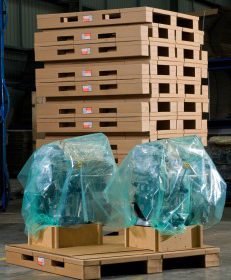
That’s why many industrial shipments require custom pallets instead of standard pallets. The pallet, restraint system, and crate are designed specifically around the equipment, lifting requirements, and freight route.
Moisture protection matters as much as impact protection
A lot of businesses focus on impact damage.
Moisture damage is often the bigger problem.
Shipping containers experience constant temperature changes during transit. Heat during the day and cooler overnight temperatures create condensation inside the container.
Over long international shipments, that moisture builds continuously.
Sensitive equipment can be damaged without a single impact occurring.
Common moisture-related problems include:
- Corrosion on machined surfaces
- Electrical failures
- Damaged control systems
- Softened cartons
- Rust formation
- Internal condensation
That’s why export packaging for machinery often includes:
- Sealed moisture barriers
- Desiccants
- Vacuum wrapping
- Corrosion protection materials
- Internal vapour barriers
For equipment travelling internationally, corrosion protection packaging becomes an important part of the packaging system, particularly for sea freight and tropical destinations.
ISPM 15 compliance is critical for export timber packaging
International timber packaging must comply with ISPM 15 regulations.
If it doesn’t, shipments can be delayed, rejected, or destroyed at the destination port.
That creates problems very quickly when:
- Installation teams are booked
- Freight schedules are fixed
- Customers are waiting
- Replacement freight becomes expensive
ISPM 15 compliance ensures timber packaging has been heat treated and certified correctly for international shipping.
A compliant export pallet or crate should be:
- Properly treated
- Correctly stamped
- Fully documented
CMTP explains the process further in this guide to ISPM 15 export pallet compliance.
Businesses exporting internationally should also review the Australian Government’s ISPM 15 timber packaging requirements before freight leaves the site.
Good crate design prevents movement during transport
Two export crates can appear similar externally while performing completely differently during freight.
The difference is usually internal restraint and load support.
Internal restraint systems matter
Heavy equipment should never move freely inside a crate.
Even minor movement creates repeated vibration damage during transport.
Sensitive machinery often requires:
- Bracing systems
- Custom mounting points
- Shock reduction systems
- Internal load restraint
This is especially important for:
- Control systems
- Pumps
- Motors
- Electronics
- Precision equipment
- Calibrated machinery
Load support matters too
Equipment weight must sit correctly across the pallet or base frame.
Incorrect support points can cause structural flex during lifting and transport.
This becomes more important with:
- Heavy equipment
- Uneven loads
- Long-span machinery
- Sensitive frames
Businesses moving industrial machinery often combine custom wooden export crates with engineered restraint systems to minimise freight movement.
Sea freight creates constant stress on packaging
Sea freight is significantly harsher than most domestic transport conditions.
Containers move continuously at sea.
Equipment vibrates for weeks.
Freight sits in ports, holding yards, and container stacks under varying weather conditions.
That creates ongoing stress on:
- Pallets
- Crates
- Restraint systems
- Wrapping materials
- Internal supports
Salt air and condensation also increase corrosion risk during long international shipments.
That’s why export packaging often combines:
- Custom pallets
- Export crates
- Corrosion protection
- Internal restraint systems
- Moisture barriers
CMTP also covers this further in how to choose the right export pallet for international shipping.
The destination site should influence the packaging design
The receiving site matters more than many businesses expect.
Some customers unload with forklifts.
Others use overhead cranes.
Some sites have smooth warehouse floors.
Others unload freight outdoors in wet yard conditions.
The packaging needs to account for:
- Unloading methods
- Lifting points
- Temporary storage
- Reusability requirements
- Safe unpacking
- Local handling equipment
A crate that works perfectly in Australia may become difficult or unsafe to unload overseas if those conditions were never considered during design.
Cheap export packaging usually becomes expensive later
Reducing packaging costs can look attractive initially.
But packaging failures often create much larger downstream costs.
Saving a few hundred dollars on packaging becomes irrelevant if:
- A machine is damaged
- Replacement parts are delayed
- Installation crews are waiting
- Production is interrupted
- Emergency freight is required
That’s why experienced operations teams often view export packaging as risk management rather than a simple purchasing cost.
CMTP also explains this further in how custom pallet design reduces freight damage.
Site assessments often identify risks early
Photos and drawings help.
Site inspections usually reveal issues nobody mentioned during the initial enquiry.
That may include:
- Uneven weight distribution
- Fragile access panels
- Poor lifting points
- Weather exposure risks
- Equipment instability
- Restricted forklift access
Those details matter when designing export packaging for high-value or fragile equipment.
CMTP’s design and engineering services are built around identifying those freight and handling risks before equipment leaves site.
What this means for your operation
Export packaging is not just about building a crate around a machine.
It is about understanding how that equipment will behave throughout the freight journey and designing protection around those conditions.
The right export packaging can help reduce:
- Freight damage
- Installation delays
- Corrosion issues
- Insurance claims
- Downtime
- Customer disputes
For fragile machinery and industrial equipment, the packaging design often matters just as much as the equipment itself once it enters the freight network.
CMTP works with manufacturers, exporters, defence contractors, food producers, and industrial businesses across Australia to design export packaging solutions for machinery, fragile equipment, and high-value freight.
That includes:
- Custom pallets
- Export crates
- Corrosion protection
- Machinery packing
- Engineered packaging systems
If you are preparing equipment for international shipping, it is worth reviewing whether the packaging is designed for the actual freight conditions involved.
You can speak with CMTP about export packaging solutions designed for real-world transport conditions.
FAQs
What is the best export packaging for fragile equipment?
The best export packaging depends on the equipment weight, fragility, freight method, destination, handling points, and moisture risk. Fragile machinery usually needs custom pallets, export crates, internal restraint, and corrosion protection rather than standard packaging.
Do I need ISPM 15 certified packaging for export?
Yes, if you are using timber packaging for international freight. ISPM 15 certified timber reduces the risk of quarantine delays, rejected shipments, or packaging being destroyed at the destination port.
How does moisture damage equipment during export?
Shipping containers heat up and cool down during transit. That creates condensation inside the container. Over several weeks, moisture can damage electronics, corrode metal surfaces, weaken cartons, and affect sensitive machinery.
Are standard pallets suitable for machinery export?
Sometimes, but not for most fragile or high value equipment. Machinery often needs custom pallet design, proper load support, restraint systems, and export crates built around the equipment and transport route.
When should I get an export packaging assessment?
You should get an assessment before shipping fragile, oversized, high value, or compliance sensitive equipment overseas. It is especially useful when machinery has uneven weight, delicate parts, corrosion risk, or special lifting requirements.