Quick answer
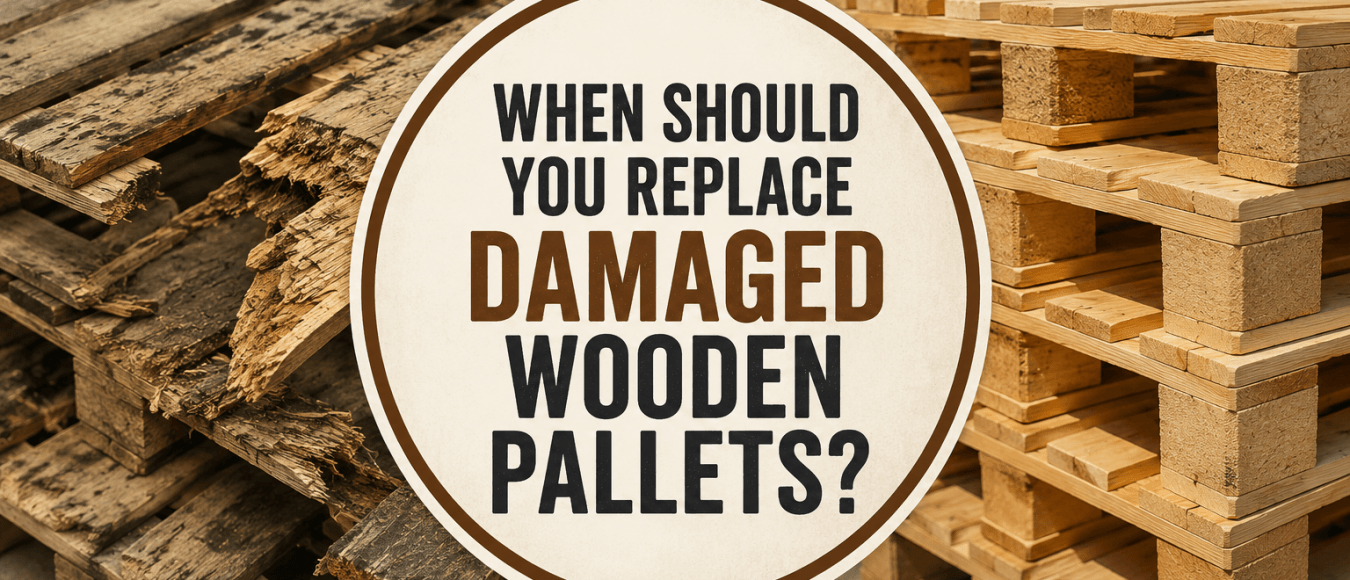
Replace damaged wooden pallets when they can no longer carry the load safely, keep products stable, or meet freight and compliance requirements. Cracked bearers, missing boards, loose nails, rot, crushed corners, and repeated forklift damage are clear signs the pallet should be repaired properly or taken out of service.
Key takeaways
A damaged pallet can cost more than it saves
Keeping a weak pallet in use might save a small amount upfront, but one failed load can cost thousands in product damage, rework, freight delays, or customer complaints.
Bearer damage is a serious warning sign
A broken deck board may be repairable. A cracked bearer is a bigger issue because it affects how the pallet carries weight.
Export loads need stricter checks
If a pallet is going overseas, damage matters more. Long journeys, container movement, moisture, and repeated handling all increase the risk.
Light damage can become a big problem under load
A pallet can look fine when empty, then flex, split, or collapse once it is carrying 800 kilograms of product.
The right answer is not always a like for like replacement
If pallets are failing often, the problem may be the pallet design, not just rough handling.
Why damaged wooden pallets should not be ignored
A damaged pallet is not just a pallet problem. It becomes a freight problem, a warehouse problem, a safety problem, and sometimes a customer problem.
Most failures start small.
A forklift hits the bearer one too many times. A deck board splits near the nail line. A pallet is left outside, takes on moisture, then dries out and weakens. Someone keeps using it because it still looks good enough for internal movement.
Then one day it ends up under an outbound load.
That is where the cost shows up.
A $40 or $60 pallet can be sitting under $5,000 worth of product. In machinery, food, produce, defence, mining, or export freight, the load value can be much higher. If the pallet fails during loading, unloading, or transport, the pallet price is no longer the issue.
The issue is damaged stock, missed delivery windows, extra handling, and customer complaints.
Common signs your wooden pallets should be replaced
Some pallet damage is obvious. Some are easy to miss unless your team knows what to look for.
Cracked or split deck boards
A cracked deck board may not mean the pallet is finished, but it should be checked.
If the crack runs through the board, spreads around the nail points, or causes the product to sit unevenly, the pallet should not be used for a heavy or high value load.
For example, cartons of light packaging may sit safely on a repaired board. A steel component, pump, gearbox, or stacked food product may not.
Weight changes everything.
Broken bearers or stringers
Bearer damage is one of the clearest signs that a pallet needs to come out of service.
The bearer is doing the heavy lifting. It gives the pallet its shape, clearance, and load strength. If it is cracked, crushed, split, or broken, the pallet is no longer carrying the load the way it was designed to.
This is common in busy warehouses where forklift tines hit the same entry points every day. From above, the pallet might look fine. Underneath, the bearer may already be weakened.
That pallet should not be trusted under a heavy load.
Missing boards
A missing board changes how weight is spread across the pallet.
The product may sag. Cartons can crush. Strapped loads can lean. Following Best Practices for Efficient and Safe Pallet Stacking and Storage becomes much harder when pallets are damaged.
This matters even more when goods are stacked.
A light pallet may suit one layer of product. Add two or three stacked layers on top, and the load changes quickly. What looked suitable on paper can become unsafe in the warehouse.
Loose nails and raised fixings
Loose nails are small, but they create real problems.
They can tear cartons, scratch finished goods, catch stretch wrap, or injure someone handling the pallet. In food and pharmaceutical environments, exposed fixings also create hygiene and contamination concerns.
Workplace injuries caused by damaged pallets and unsafe handling practices remain a recognised risk in Australian warehouses, with guidance available through Safe Work Australia.
If nails are lifting, the board is usually moving. That means the pallet is already losing strength.
Moisture damage, rot, or mould
Wooden pallets can handle normal industrial conditions when they are built and stored correctly. Problems start when timber is left wet for too long or exposed to poor storage conditions.
Look for soft timber, dark staining, mould, swelling, or timber that breaks away under pressure.
This is especially important for businesses using Kiln Dried Pallets for Moisture Free Storage, food transport, export freight, and long term storage. A pallet affected by moisture may still look usable, but it may not hold up once it is moved, stacked, or shipped.
Crushed corners and repeated forklift damage
Corners take a beating.
In a fast moving warehouse, pallets are bumped, dragged, pushed, and lifted all day. A single knock may not matter. Repeated impact does.
Crushed corners can affect stacking, wrapping, racking, and forklift handling. If the pallet no longer sits square, the load may not sit square either.
That is when operators start compensating with slower handling, extra straps, or extra care. All of that costs time.
Repair or replace? A simple way to decide
Not every damaged pallet needs to be thrown out. Some can be repaired safely.
The question is whether the repair restores the pallet to a condition that suits the load, the handling method, and the freight journey.
| Pallet condition | Usually repairable | Usually replace |
| One loose deck board | Yes | No |
| One cracked deck board on a light duty load | Sometimes | Sometimes |
| Multiple cracked boards | No | Yes |
| Broken bearer or stringer | No | Yes |
| Missing boards across the load area | Sometimes | Sometimes |
| Protruding nails or fixings | Yes | No |
| Rot, mould, or soft timber | No | Yes |
| Export pallet with structural damage | No | Yes |
| Pallet no longer sits flat | No | Yes |
| Repeated failures in the same area | No | Yes |
A good rule is this.
If the damage affects how the pallet carries weight, how the forklift handles it, or how the product sits on it, do not keep using it without a proper repair or replacement.
How damaged pallets affect freight and warehouse costs
The true cost of a damaged pallet rarely appears on the pallet invoice.
It shows up somewhere else.
A warehouse team spends extra time re-stacking a load because the pallet has shifted. A truck is delayed while staff swap a damaged pallet before dispatch. A customer receives crushed cartons and sends photos back to the sales team. An export shipment needs repacking because the pallet is not fit for the journey.
These are not rare situations.
They happen in busy operations where pallets move fast and nobody has time to inspect every board closely.
That is why pallet checks need to be simple and practical. Your team does not need a complicated system. They need to know which pallets can stay in use, which ones need repair, and which ones should go straight to the reject area.
When export pallets should be replaced
Export freight is less forgiving than local freight.
A pallet may be handled at your site, by a transport company, at a depot, at a port, inside a container, overseas, and again at the final destination. Each step adds movement and risk.
If a pallet is already damaged before it leaves your site, the journey will not improve it. The same principles discussed in How to Choose the Right Export Pallet for International Shipping apply here.
For export loads, replace the pallet if there is structural damage, moisture damage, broken bearers, missing boards, or any sign the load will not stay stable.
This matters for ISPM 15 Explained: Exporting Pallets the Compliant Way too. Treatment and marking are only part of the picture. The pallet still needs to be physically suitable for the freight. A compliant pallet that is structurally weak is still the wrong pallet.
Why repeat pallet damage may point to the wrong pallet design
If you are replacing the same damaged pallets every week, the issue may not be the individual pallet.
It may be the specification.
This is where many businesses waste money. They keep buying the same pallet because that is what has always been ordered. But the operation may have changed.
The product might be heavier now. The warehouse may be stacking higher. Forklift traffic may have increased. Loads may be travelling further. A customer may now require a cleaner presentation on delivery. Export work may have grown.
A medium duty pallet might be fine for single layer warehouse storage. Heavier products may require Heavy Duty Pallets for Machinery and Mining Equipment instead.
Some sites also benefit from simple identification systems. Colour coding bearers, for example, can help teams quickly separate heavy, medium, and light duty pallets in the yard. That reduces handling errors and stops the wrong pallet being used for the wrong load.
Who should check pallets before use?
Pallet checks should not sit with one person only.
Forklift drivers, warehouse supervisors, dispatch teams, and anyone loading outbound freight should know the basic signs of pallet failure.
The check does not need to take long.
Before loading, look at the bearers, deck boards, nails, corners, and whether the pallet sits flat. If the pallet is going under heavy goods, high value stock, food products, export freight, or machinery, take a little more care.
A damaged pallet used for internal movement may seem low risk. The problem is that internal pallets often end up in dispatch when the team is busy.
That is how weak pallets slip into the supply chain.
Why working with the right pallet supplier matters
A good pallet supplier should do more than sell replacements. Procurement teams should understand What Procurement Managers Should Ask a Pallet Supplier before making long term purchasing decisions.
If a pallet is failing because it has reached the end of its working life, replacement makes sense. If pallets are failing because the design is too light, the entry points are wrong, the bearers are taking repeated forklift impacts, or the load has changed, then buying the same pallet again will keep causing the same problem.
Experienced pallet manufacturers will look at the load, handling equipment, storage conditions, freight route, stacking requirements, and compliance needs before recommending a solution.
If the same pallets keep failing, buying more of the same pallets usually will not fix the problem. Often the issue relates to pallet design, which is why many businesses review How Custom Pallet Design Reduces Freight Damage and Custom vs Standard Pallets: Which One Do You Need? when recurring failures occur.
FAQs
Can damaged wooden pallets be repaired?
Yes, some damaged wooden pallets can be repaired. A loose board, lifted nail, or minor deck damage may be repairable. If the bearer is broken, the timber is rotten, or the pallet no longer sits flat, replacement is usually the safer option.
How do I know if a pallet is unsafe?
A pallet is unsafe if it has broken bearers, missing boards, raised nails, severe cracks, soft timber, rot, crushed corners, or movement under load. If you would not trust it under the full product weight, do not use it.
Should damaged pallets be used for internal warehouse movements?
Only if the damage is minor and the pallet is still safe for the load. Be careful with this practice. Internal pallets often end up being used for outbound freight during busy periods, which can move the risk further down the supply chain.
Are export pallets held to a higher standard?
Yes. Export pallets need to be compliant and structurally sound. ISPM 15 treatment does not make a damaged pallet safe. If the pallet is cracked, unstable, or weakened, it should be replaced before dispatch.
What should I do if pallets keep breaking?
If pallets keep breaking in the same way, review the pallet specification. The load may be too heavy, the pallet may be too light, the forklift entry points may not suit your handling process, or the operation may have changed since the pallet was first chosen.
Related articles
- How Custom Pallet Design Reduces Freight Damage
- Custom vs Standard Pallets: Which One Do You Need?
- ISPM 15 Explained: Exporting Pallets the Compliant Way
- Why Use Kiln Dried Pallets for Moisture Free Storage?
- How to Choose Export Packaging for Fragile Equipment?
Need help deciding whether to repair or replace your pallets?
If your wooden pallets are wearing out, failing under load, or causing issues in dispatch, CMTP can help you work out whether you need repairs, replacements, or a better pallet design.
CMTP works with manufacturers, exporters, food and produce businesses, logistics teams, defence suppliers, machinery companies, and industrial operations across Australia. Our team can assess your load requirements, handling process, freight conditions, and compliance needs, then recommend pallets that suit the job properly.
Contact CMTP to discuss your pallet requirements or request a quote.